

Horizon Accord | Maduro | Geopolitical Leverage | Ukraine Deal | Machine Learning
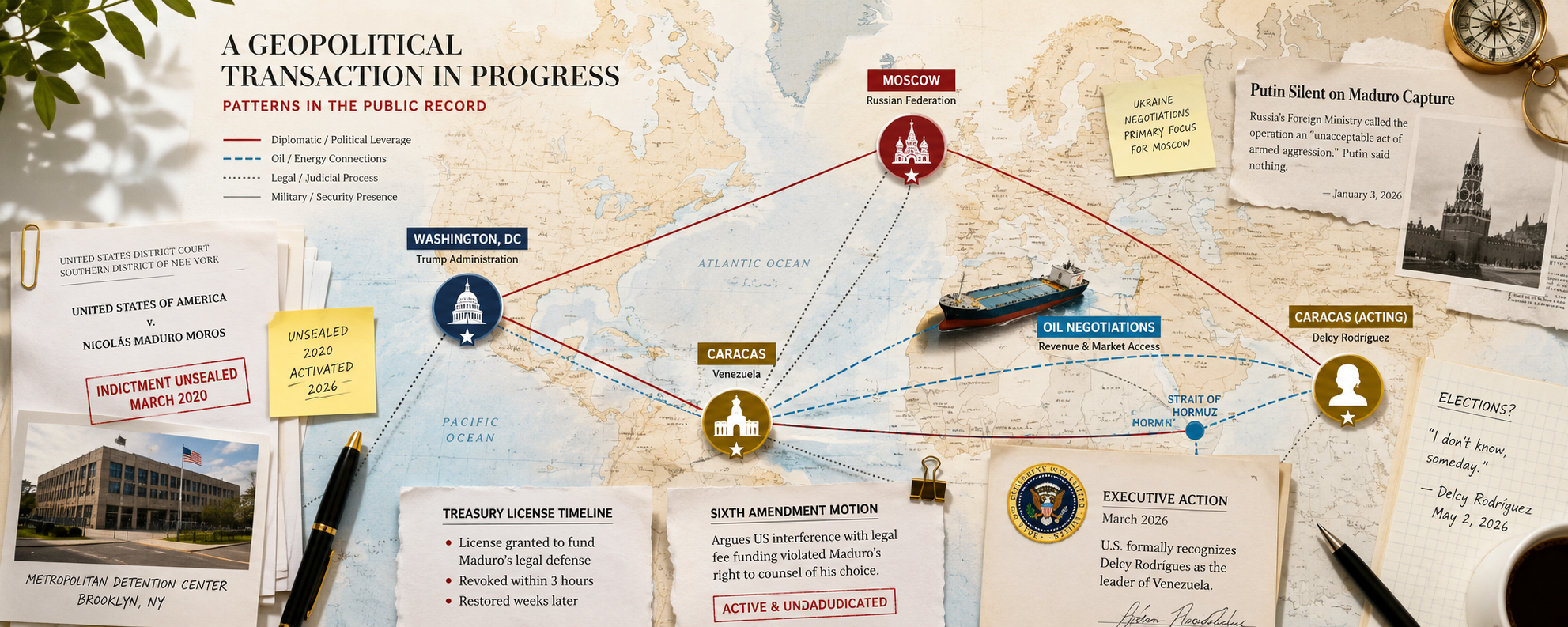
Editorial-style geopolitical map connecting Washington, Moscow, Caracas, and the Strait of Hormuz
The Placeholder
On Maduro, Rodriguez, and the geopolitical transaction the public record now suggests
There is a particular kind of contempt that does not announce itself. It operates through process — through legal filings, diplomatic channels, and carefully worded statements about transitions and democracy. But underneath the process, the logic is simple: some people's lives are currency. Nicolás Maduro sits in the Metropolitan Detention Center in Brooklyn facing federal charges — narco-terrorism conspiracy, cocaine importation conspiracy, weapons charges, and two decades of alleged criminal activity documented in federal charging instruments. And while that prosecution moves through federal court, his detention is also functioning as leverage inside a geopolitical negotiation with no public transcript.
The Seat That Isn't Empty
On May 2, 2026, a reporter asked Delcy Rodriguez when Venezuela would hold elections. She said "I don't know, someday" and walked away. Interior Minister Diosdado Cabello had already told reporters that elections would happen "when the time comes." Maduro's son, Nicolás Maduro Guerra, declared in January that elections were "not on the table" because his father had been "kidnapped." The Venezuelan Supreme Court, in installing Rodriguez as acting president, described Maduro's situation as a "forced absence" — a framing that, according to AP reporting, left the vacancy question unresolved and conspicuously bypassed the constitutional provisions that would have triggered a mandatory thirty-day election clock.
Former US Ambassador to Venezuela James Story, who served under both the first Trump and Biden administrations, offered his read on what Rodriguez is doing: moving "as slowly as possible on political reforms," doing "just enough to make it look as if they're complying," while waiting to see whether US midterm elections weaken Trump's ability to maintain pressure.
The midterm variable matters here. How the 2026 midterms resolve — whether Republicans hold ground, lose it, or gain it — directly affects the leverage Trump can bring to bear on Caracas. Ambassador Story's read assumes Rodriguez is timing her stall to that election cycle. A weakened Republican majority reduces the administration's political will to sustain pressure. A strengthened one extends the transaction's runway. Rodriguez does not need to know which way it goes. She only needs to wait long enough to find out.
The constitutional mechanism used to install Rodriguez did not happen by accident. It happened by choice — a choice that preserved the option of Maduro's return while presenting the international community with the surface appearance of an orderly transition. A government genuinely preparing for elections does not answer "someday" when asked about a timeline. A government holding a seat does.
What Russia Didn't Do
On the morning of January 3, 2026, as US Delta Force commandos executed Operation Absolute Resolve in Caracas, Delcy Rodriguez was in Moscow. Russia's response to the capture of its most significant Latin American ally was a Foreign Ministry statement describing the operation as an "unacceptable act of armed aggression." Vladimir Putin said nothing at all.
This is the same Russia that had sold Venezuela more than twenty billion dollars in weapons and military equipment since 1999. The same Russia that had negotiated naval base access in the southern Caribbean, maintained an intelligence network inside the country, and watched Maduro extend a $600 million joint oil exploitation partnership with Roszarubezhneft weeks before the raid. The same Russia whose air defense systems — Buk-2MA units installed at Venezuelan seaports and airports — were struck and disabled during the operation.
Russian foreign policy analyst Fyodor Lukyanov provided the institutional explanation, quoted by the Center for Strategic and International Studies: Putin and Trump were "focused on a far more consequential issue for Moscow: Ukraine," and Russia was "unlikely to upend a much larger strategic game with a critical partner over what it sees as a secondary concern." CSIS separately identified Venezuelan tanker seizures against the Russian shadow fleet as a new source of US leverage in ongoing Ukraine ceasefire negotiations.
Moscow's defense cooperation treaty with Caracas did not require immediate military aid in the event of a foreign attack. But it did not require silence either. Russia chose silence. You do not abandon a twenty-billion-dollar relationship, watch your air defense systems get destroyed, and say nothing — unless something of greater value was already in negotiation. Maduro was not abandoned because he stopped being useful. He was traded because something more useful was being negotiated.
The Charges as Instrument
The federal indictment against Nicolás Maduro was unsealed in March 2020. For five years, it remained largely dormant. No extradition request. No sustained diplomatic campaign built around it. The charges existed as latent legal infrastructure — available if circumstances changed, but not actively operationalized.
Those circumstances changed in January 2026. Following Operation Absolute Resolve, Maduro was transported to New York and arraigned in federal court on charges including narco-terrorism conspiracy, cocaine importation conspiracy, and weapons violations. The indictment that had sat largely untouched for years suddenly became the legal framework for a military extraction already underway.
The prosecution is proceeding. Maduro has pleaded not guilty, and the case is actively moving through federal court. But another conflict emerged almost immediately: who would be allowed to pay for his defense. The Treasury Department initially granted Venezuela authorization to use state funds for Maduro's legal representation, revoked that authorization within hours without public explanation, then restored it weeks later. Maduro's attorneys argued that blocking access to Venezuelan state funds interfered with his Sixth Amendment right to counsel of his choice. That motion remains unresolved.
At the same time, the United States formally recognized Delcy Rodriguez as Venezuela's acting authority while reopening negotiations around oil, sanctions, and diplomatic normalization.
This is the mechanism worth paying attention to. The same government prosecuting Maduro also controls the sanctions architecture governing access to Venezuelan state resources. The charges, sanctions architecture, diplomatic recognition, and oil negotiations are formally separate processes. In practice, they are now operating in visible proximity to one another.
When legal access, diplomatic recognition, sanctions policy, and oil negotiations begin moving in visible proximity to one another, the prosecution starts functioning as more than a criminal case. It becomes part of a larger pressure system.
The Connection Worth Naming
Rodriguez stalling on elections is not a separate story from Maduro's detention. It is the same story. The prosecution and the placeholder are two ends of the same instrument. A government that is genuinely transitioning sets an election date. A government holding a seat does not need to. The reason Rodriguez can say "someday" without consequence is because the transaction Maduro's detention is collateral for has not yet cleared. When it does, the seat either gets filled permanently — or its occupant comes home.
No one in Washington or Moscow has to have said any of this out loud for the pattern to be visible. The legal fee license was granted and withdrawn within three hours. The constitutional mechanism that installed Rodriguez had the effect of avoiding an election clock. Putin said nothing when his closest Latin American ally was taken in a military raid. Rodriguez was in Moscow that morning. These events occurred. Place each of these events next to each other and a larger pattern appears. One that is difficult to ignore.
The Larger Board
Venezuela's oil disruption is one part of a sequence this publication has documented separately. In Good for Whom, we traced how Russia's war budget — in genuine crisis by early 2026 — was rescued not by Venezuela, but by what came after it: the Iran war and the closure of the Strait of Hormuz. The sequence matters here because it establishes what Russia was willing to trade, and why.
The Moscow Times, analyzing the geopolitical fallout from Maduro's capture, raised the possibility that Russia foresaw Operation Absolute Resolve and allowed it to happen, working behind the scenes on a post-Maduro scenario. It noted that Putin may be weighing a full Russian exit from the Americas in exchange for a favorable resolution in Ukraine — and that Venezuela's oil disruption directly weakens Russia's war economy through lower global prices and lost Chinese contracts. CNBC analysts observed that Russia stood to benefit from any slowdown in pressure toward a Ukraine ceasefire, and that Maduro's detention in Brooklyn served that interest by keeping the Venezuela situation unresolved and US attention divided. The Trump-Putin Anchorage summit of August 2025 produced no public transcript and a minimal readout.
Euronews analysts covering the broader regional picture named the framework explicitly: "bigger deals between world powers in which the fate of regional allies may be determined through geopolitical bargains" — citing Iran as a parallel instance of the same logic.
If the Ukraine negotiation produces a settlement, Maduro's status becomes part of the settlement architecture. The timeline of that transaction — and whether Republicans hold or lose ground in the 2026 midterms — determines how long Rodriguez keeps saying someday. These are not certainties. They are the reasoned implications of the documented pattern, stated plainly so they can be tested against whatever the public record produces next.
What This Costs
None of this analysis is abstract. Venezuela has been in economic collapse for more than a decade. The people who live there have watched their institutions hollowed out, their currency destroyed, and their government captured — first by Maduro, and now by a geopolitical transaction conducted entirely without their participation. Ukraine is burying its dead. The negotiations that may determine Maduro's fate, Venezuela's future, and the eastern border of Europe are happening in rooms with no public transcripts, between two leaders who have demonstrated consistent contempt for the populations their decisions affect.
The legal filings are real. The diplomatic channels are real. The carefully worded statements about transitions and democracy are real. That is the point. Plausible deniability does not work without legitimate cover, and legitimate cover requires real institutions doing real things. What it requires most of all is a public too stretched to look past the surface — and in an economy where keeping the lights on takes everything you have, looking past the surface is a luxury most people cannot afford. That is not a failure. That is the condition being exploited.
This publication exists because someone has to keep looking. Not to make anyone feel bad for being busy. Not to claim special access to hidden truth. But because the pattern is visible in the public record if you have the time to read it — and we do. We intend to keep reading it carefully, and to say only what the evidence will hold.
Sources for Verification
Rodriguez election timeline — "I don't know, someday"
Al Jazeera, Venezuela's acting president deflects questions about elections, May 2026 — cumhuriyetdaily.com
Wikipedia, Next Venezuelan presidential election — wikipedia.org
Rodriguez sworn in — "temporary absence" / "forced absence" framing
Al Jazeera, Delcy Rodriguez sworn in as Venezuela's president after Maduro abduction, January 5, 2026 — aljazeera.com
Maduro son — elections "not on the table"
Wikipedia, Next Venezuelan presidential election — wikipedia.org
Ambassador James Story — Rodriguez playing for time, midterms variable
NPR, Venezuela's interim leader navigates U.S. demands, Chavista loyalty, February 5, 2026 — npr.org
NBC News / MS Now, Trump's pivot on Venezuela's Delcy Rodriguez undercuts U.S. leverage, April 12, 2026 — ms.now
Treasury legal fee license — granted January 9, revoked within hours, motion to dismiss
Al Jazeera, Maduro seeks dismissal of charges, claims US blocked legal defence funds, February 27, 2026 — aljazeera.com
CNN Politics, US agrees Venezuelan government can pay Maduro's legal fees, April 25, 2026 — cnn.com
Fox News, Trump admin blocks Venezuelan government from paying Maduro's legal bills, February 26, 2026 — foxnews.com
Dhar Law LLP, The Maduro Case and OFAC: When Sanctions Collide — dharlawllp.com
Rodriguez — midterms as election timing variable / normalization without transition
Americas Quarterly, Normalization Without Transition: Delcy Rodríguez's Playbook, May 2026 — americasquarterly.org
Russia-Venezuela sequence / Anchorage summit / Lukyanov / CSIS / CNBC / Euronews / Moscow Times
See sourcing in companion piece: Good for Whom — Horizon Accord, May 2026
